









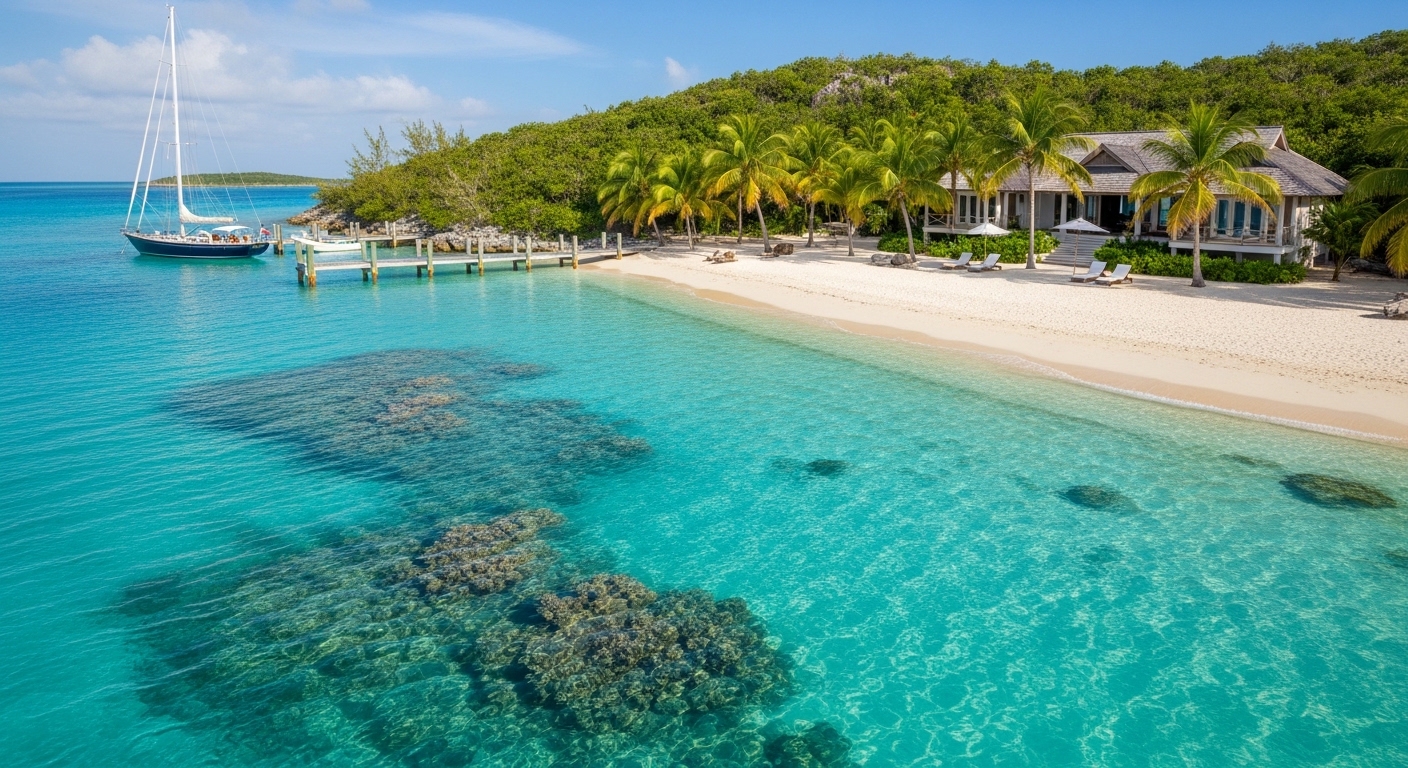
In an era when fame feels like a permanent spotlight and the planet itself seems smaller by the day, the idea of a private island still carries mythic weight. It speaks not just to wealth, but to a deeper human longing for refuge, for a place where the self can be rewritten without an audience. Johnny Depp Island, officially known as Little Hall’s Pond Cay, embodies that longing with unusual intimacy. Tucked within the Bahamian archipelago, this 45-acre slice of the Exumas is more than celebrity real estate. It is a quietly radical experiment in luxury seclusion, tropical conservation, and personal myth-making.
What began as a spontaneous discovery during the filming of a blockbuster pirate saga has evolved into a carefully tended sanctuary. Here, solar-powered luxury meets island stewardship in a setting protected by one of the Caribbean’s earliest marine parks. The story of Johnny Depp Island is not merely one of acquisition. It is a narrative about how a public figure sought, and largely created, a version of paradise that feels both deeply private and subtly progressive.
Discovery and Acquisition: A Pirate’s Dream Washed Ashore
The tale opens in 2003, amid the turquoise waters where Johnny Depp was filming the first Pirates of the Caribbean movie. The actor, already a global star with a reputation for eccentric charm, found himself drawn to the Exuma Cays. One cay in particular caught his eye: Little Hall’s Pond Cay, an undeveloped 45-acre outcrop roughly 60 miles southeast of Nassau. By 2004, he had purchased it for $3.6 million.
At the time, the island had no infrastructure, no buildings, nothing but white sand, limestone, and the kind of raw natural beauty that the Bahamas have guarded for centuries. Depp, who had consulted his mentor Marlon Brando about the idea of owning an island, saw something more than real estate. He saw escape. The purchase aligned perfectly with his on-screen persona, yet it was rooted in something quieter: a need to step outside the machinery of Hollywood and reconnect with something elemental.
Little Hall’s Pond Cay sits within or immediately adjacent to the Exuma Cays Land and Sea Park, established in 1959 as one of the Western Hemisphere’s first no-take marine reserves. This location was no accident. It placed the island in a zone of deliberate tropical conservation, where fishing is restricted and the ecosystem is fiercely protected. For an actor whose public image had long flirted with rebellion and reinvention, buying into a protected paradise carried a certain poetic logic.
Crafting a Personal Eden: Beaches, Buildings, and Namesakes
Once the island was his, Depp began shaping it with characteristic flair but surprising restraint. He constructed a ranch-style main house offering panoramic 360-degree views, along with a beach house, a bamboo yurt, and a roundhouse. Travel across the cay happens by golf cart, preserving the silence. There are six beaches, each given a name that reads like a chapter in Depp’s personal lore.
Two honor his children: Lily-Rose and Jack. One recalls his former partner Vanessa Paradis. Another, dubbed Gonzo or Ponzo, pays tribute to Hunter S. Thompson, complete with glass tables etched with the writer’s likeness. A fifth is named for Brando. The sixth completes a circle of intimate references, turning the shoreline itself into a living map of relationships, influences, and affections. These names transform what could have been generic luxury into something far more human and idiosyncratic.
The structures themselves were designed for harmony with the environment rather than dominance over it. Early reports from 2008 noted Depp’s collaboration with environmentalist Mike Strizki to explore solar hydrogen power, an ambitious off-grid solution for self-sufficiency. While later accounts emphasize reliable solar-powered systems powering the residences, the intent remained consistent: create a functional yet low-impact retreat. Rainwater collection and careful material choices further underscored a commitment to island stewardship that went beyond mere aesthetics.
Powering Paradise: Solar Innovation Meets Caribbean Reality
In the context of Caribbean private islands, Johnny Depp Island stands out for its early embrace of sustainable technology. Solar power was not an afterthought but a foundational choice for a place without grid connections. The move toward solar, and the initial exploration of hydrogen storage, reflected broader conversations about luxury seclusion in fragile ecosystems. Islands in the Bahamas are especially vulnerable to rising seas and intensifying storms; choosing renewable energy here was both practical and symbolic.
The island’s inclusion in the protected park reinforced this ethos. No one is permitted to disturb the flora or fauna. Depp himself developed a fondness for the local wildlife, famously naming a five-foot iguana “Iggy” and speaking of it with genuine affection in interviews. The cay’s pristine condition, maintained through deliberate restraint, stands in quiet contrast to more commercialized developments elsewhere in the region.
This approach to solar-powered luxury offers a model that feels increasingly relevant. In an age when many celebrity properties prioritize spectacle, Depp’s island prioritized seclusion without sacrificing ecological awareness. It is a form of stewardship that acknowledges the privilege of ownership while attempting to tread lightly on the land.
The Lore of Seclusion: Escapism, Healing, and Personal Myth
Over the years, Little Hall’s Pond Cay accumulated its own lore, much of it tied to Depp’s need for decompression. He has described the island as the most “pure and beautiful” place he has ever known. In a 2009 interview, he spoke of it as essential escapism, a place to “return to normalcy” after intense film roles. He joked about becoming “Ruler of the Exumas” and installing Guinness on tap, revealing a playful side to his attachment.
The island hosted meaningful milestones. In 2015, Depp and Amber Heard held their wedding celebration on one of its white-sand beaches. It also served as a private space during periods of personal transition, including detox and recovery. These stories, filtered through tabloid coverage, add layers to the cay’s narrative without diminishing its role as sanctuary.
Visitors are firmly discouraged; polite no-trespassing signs line the shores. Yet the island’s story has circulated among sailors and yachting enthusiasts who anchor nearby in the park’s protected waters. It has become part of Exuma folklore: a celebrity enclave that remains resolutely off-limits, fueling the mystique of Caribbean private islands.
Celebrity Real Estate and the Ethics of Paradise
Johnny Depp Island exists within a larger cultural shift. The Bahamas have long attracted high-profile owners seeking privacy amid natural splendor. Yet in recent decades, the surge in private-island purchases has raised questions about exclusivity, environmental impact, and local benefit. Depp’s choice to integrate solar technology and respect park boundaries offers one thoughtful response to those tensions.
The island reflects a broader conversation about luxury in the 21st century: one that balances seclusion with responsibility. It is not a resort or a rental property but a personal holding, maintained with evident care. In that sense, it quietly challenges the stereotype of celebrity real estate as pure indulgence. Instead, it suggests a possible path toward more conscious ownership, where privilege funds preservation rather than extraction.
This matters now more than ever. As climate awareness grows and overtourism strains fragile destinations, stories like this one invite reflection on how the ultra-wealthy engage with the places they claim as their own. Johnny Depp Island does not solve systemic issues, but it models an alternative: one rooted in restraint, personal connection, and environmental mindfulness.
A Sanctuary for the Present
Today, Little Hall’s Pond Cay remains under Depp’s ownership, a steadfast presence in the Exumas despite the actor’s very public personal and professional journeys. Its endurance speaks to the depth of his attachment. What began as a film-inspired impulse has matured into a lasting testament to the value of unspoiled space.
In the end, the complete history and lore of Johnny Depp Island reveal something universal. We all crave places where the noise fades and the self can breathe. For one of the world’s most recognizable figures, that place is a solar-powered cay where iguanas roam freely and beaches carry the names of loved ones. It is a reminder that even in the most exclusive corners of the Bahamian archipelago, the most compelling stories are the human ones: of discovery, care, and the quiet art of letting a paradise remain, as much as possible, itself.
You May Also Like: Sosoactive: Cultivating a Diverse Platform for Holistic Wellness and Lifestyle Insights