









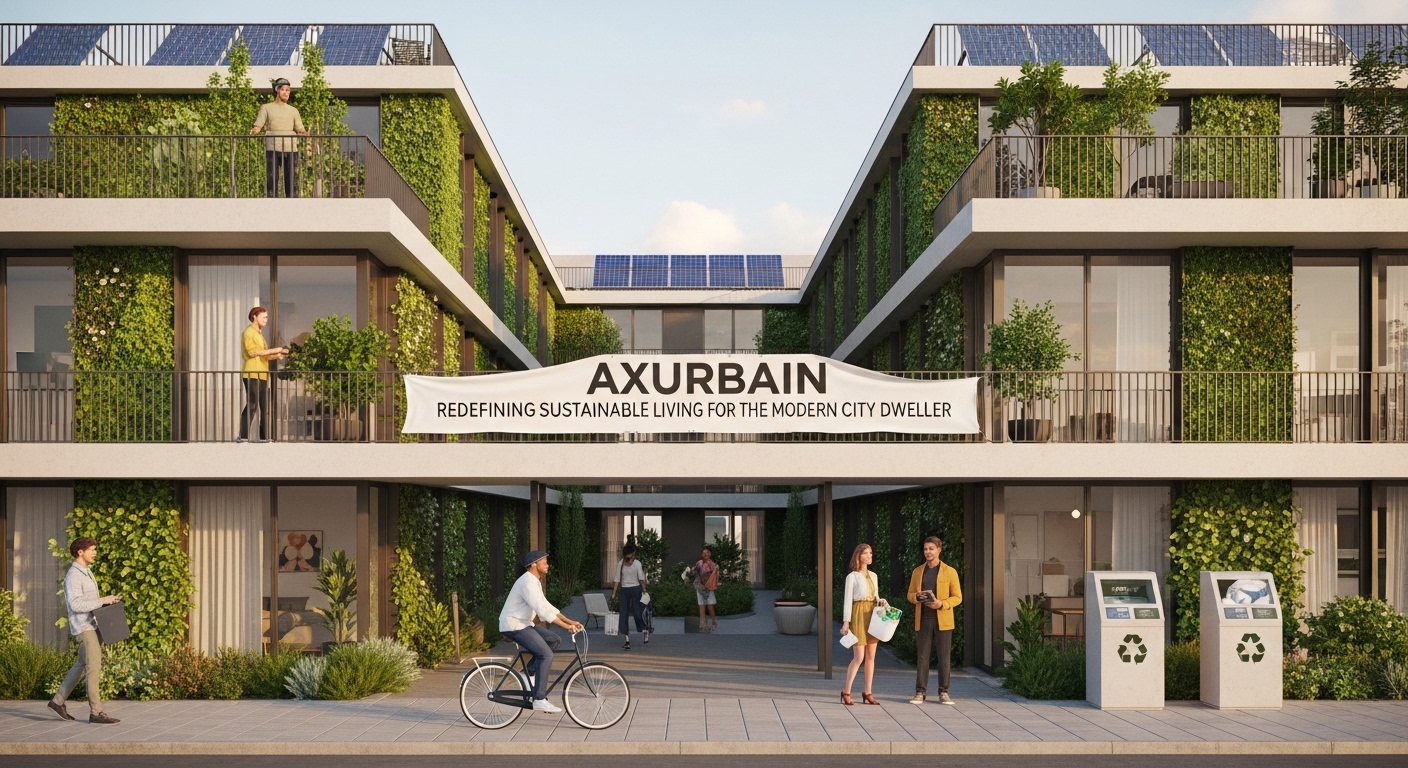
Cities have long been engines of ambition, yet for many they have also become places of quiet exhaustion. Gridlocked streets, air that stings the lungs, and housing that demands more than it returns. Against this backdrop, Axurbain has surfaced not as a flashy slogan but as a deliberate shift in how we imagine urban life. It proposes that the future city must be engineered around people first, with technology, nature, and culture working in quiet concert rather than as competing afterthoughts.
This is not another corporate vision of gleaming towers monitored by algorithms. Axurbain reframes sustainable urbanism as a daily practice of adaptation, one that asks what it means to live well when half the planet already calls a city home and the number keeps climbing. It draws on decades of environmental science, design experimentation, and social activism, yet feels distinctly contemporary in its refusal to separate ecological repair from cultural vitality.
The Cultural Moment That Made Axurbain Necessary
The pandemic years exposed the fragility of our urban systems with brutal clarity. Remote work scattered routines, climate events flooded subways, and inequality mapped itself onto postcodes. Suddenly, the old bargain, endure congestion for opportunity, felt unsustainable. At the same time, a new generation of urbanites began demanding more than efficiency. They wanted air they could breathe, neighborhoods that invited lingering, and spaces that respected both their digital lives and their need for stillness.
Axurbain emerged from this tension. It treats the city as a living system rather than a machine to be optimized. Where earlier smart-city rhetoric often prioritized sensors over souls, this approach insists that data must serve human experience. It folds together green architecture, IoT in urban planning, and PropTech not as isolated tools but as threads in a larger fabric of human-centric design.
Biophilic Design as Daily Medicine
One of the most tangible ways Axurbain reshapes city living is through biophilic design, the deliberate weaving of nature into the built environment. Think vertical forests climbing apartment blocks, green corridors that double as flood defenses, and rooftops turned into community orchards. These are not decorative flourishes. They lower urban temperatures, filter air, and, crucially, restore a sense of psychological belonging that concrete alone cannot provide.
In practice, this means retrofitting older districts rather than razing them. Urban renovation under Axurbain principles favors adaptive reuse: former industrial warehouses become mixed-use hubs with passive solar design and rainwater systems. The result is lower embodied carbon and neighborhoods that feel layered with memory instead of erased for the next glass tower.
Smart Infrastructure That Stays in the Background
Technology plays a supporting role, never the star. IoT in urban planning allows traffic signals to breathe with real-time demand, waste bins to signal collection only when full, and energy grids to balance renewable inputs without blackouts. Yet Axurbain distinguishes itself by embedding digital inclusion at every layer. Not everyone owns the latest device or trusts data collection. The framework therefore demands transparent governance and low-tech alternatives so that elderly residents in a peripheral neighborhood are not left behind while downtown glows with connectivity.
PropTech enters here as well, but reimagined. Instead of platforms that accelerate speculative real estate, Axurbain-aligned tools help cooperatives finance energy-efficient upgrades or enable residents to co-design public spaces through simple digital interfaces. The goal is resilience without exclusion.
Carbon-Neutral Cities as Cultural Projects
Achieving carbon-neutral cities requires more than policy papers. It asks cities to treat climate response as a creative act. Axurbain encourages districts where walking and cycling are the default, not the virtuous exception. Mixed-use development shrinks commutes; shared mobility fleets replace private cars; and public spaces become theaters for local culture rather than mere transit corridors.
Global examples illustrate the potential. Copenhagen has long pursued carbon neutrality through integrated cycling infrastructure and district heating powered by renewables. Singapore layers smart sensors with extensive park connectors, proving that density and greenery need not be enemies. In Latin America, Medellín transformed former no-go zones into libraries and cable-car-linked neighborhoods, showing how sustainable urbanism can also be a tool for social repair.
What these places share, and what Axurbain amplifies, is an understanding that technical solutions only endure when they resonate culturally. A park that no one feels ownership over will be neglected. A smart grid that feels imposed will breed suspicion.
The Necessary Tensions
Any honest account of Axurbain must acknowledge its risks. Green upgrades can accelerate gentrification if affordability is not hardwired into the plan. Digital tools can widen divides unless privacy and access are non-negotiable. In rapidly growing cities of the Global South, where informal settlements house millions, top-down smart-city blueprints have sometimes displaced rather than empowered. Axurbain’s strength lies in its insistence on participatory processes, yet translating that ideal into messy local politics remains the real test.
There is also the question of scale. A single neighborhood can adopt biophilic retrofits and IoT monitoring with relative ease. Scaling to an entire metropolis demands coordination across fragmented governance, budgets stretched by competing crises, and cultural shifts that cannot be mandated.
A City That Feels Like Home Again
At its best, Axurbain offers something subtler than efficiency metrics or LEED certifications. It suggests that a sustainable city is one where people can form attachments, where daily life includes moments of beauty and surprise, and where the built environment supports rather than undermines the messy, creative work of being human together.
This is not nostalgia for a pre-industrial village. It is a forward-looking wager that technology and ecology can be placed in service of culture. In an age of planetary limits, the most radical act may be designing cities that invite us to slow down, notice one another, and imagine shared futures.
The modern city dweller does not need another utopian render. What they need is evidence that urban life can be repaired without being sanitized, that sustainability can be joyful rather than penitential. Axurbain, still evolving and imperfect, points in that direction. Whether it becomes the prevailing grammar of twenty-first-century cities will depend less on the sophistication of its sensors than on our collective willingness to demand that every innovation answer to lived experience.
You May Also Like: The Essential Guide to Living a Holisticke Lifestyle